Dotted Notes and Tied Notes
Dots are used in music to increase the duration of a note or rest.
Dotted rests aren’t needed for grade 1, so we won’t cover them in this lesson, only dotted notes.
Dotted notes look like this:
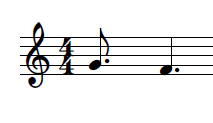
The dot is placed to the right of the notehead.
If the notehead is on a line: the dot is placed in the space directly above the line (as with the dotted G above).
If the notehead is between the lines: the dot is placed in the space to the right of the notehead (as with the dotted F above).
Effects of Dots
Dots increase the value of a note by half.
This means a dotted crotchet would be equal to a crotchet and a quaver, (1 ½ a crotchets).
Key Point
Dots increase the value of a note by half.
Here is a graphical visualisation of the different dotted note values which you may see at grade 1:

Dots in Practice
Listen to these few bars of a piece in 3/4 time. At the start of each bar it has a dotted crotchet followed by three quavers.
Notice how the three quavers are the same length as the dotted crotchet.
Chopin Op. 69/2
Listen while following the notation below.

Tied Notes
A tie is another way of increasing the length of a note.
If two consecutive notes of the same pitch are tied together, the length of the notes are added together and the note is only played once.
The tie can be used to hold notes across bar lines or create note lengths when are not otherwise possible, such as notes lasting 2 ¼ beats – produced by tieing a minim and a quaver together.
Here are some examples of ties, with a metronome in the background signifying each crotchet beat:
Key Point
If two consecutive notes of the same pitch are tied together, the lengths of the notes are added together and the note is only played once.
Tied notes within one bar
Listen while following the notation below.
There is a metronome in the background to help you hear where the beats are.

Tied notes across a bar line
Listen while following the notation below.
There is a metronome in the background to help you hear where the beats are.

Tied Notes in Practice
Here is a few of the opening bars of an excerpt that uses tied notes…
Chopin Op. 69/2
Listen while following the notation below.

Summary
As you can see, ties and dots are both useful tools, and they are both used extensively throughout music of all periods. You will consistently encounter them throughout your musical life.