In the previous lesson, we explored how music is divded into beats, and different notes represent different durations of beats.
However, not only is music divided into beats, these beats are grouped together into equal patterns. Each group/pattern of beats is called a bar or measure, the length of each bar or measure is represented by time signatures.
Time Signatures Explained
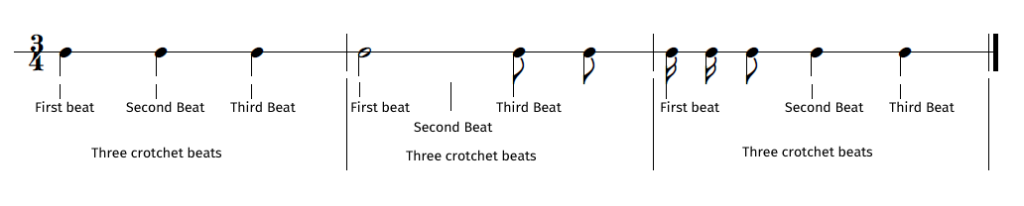
Time signatures state the amount of beats between two bar lines. They are two numbers on top of one another.
EXAMPLE
A time signature looks like this:
The top number in a time signature signifies the number of beats in each bar.
The bottom number signifies the type of beat in a bar. In this instance, a 4 in the bottom means each beat is a crotchet.
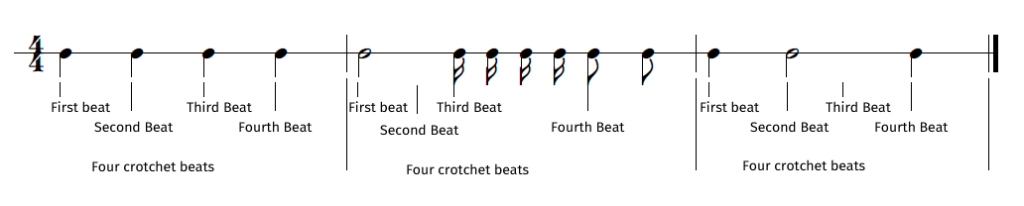
Therefore, the time signature we just saw, means there is 4 crotchet beats in each bar.
Key Point
Time signatures are not fractions.
They are two numbers, representing the number of beats, and type of beats.
There are three time signatures you need to know about for grade one, 2/4; 3/4; and 4/4.
Here is what they all mean:
TIME SIGNATURES EXPLAINED
Bar Lines and Bars
So, what is a bar?
A bar is a section of music that contains a set number of beats, determined by the time signature.
A bar line is a vertical line that separates one bar from the next.
EXAMPLE
Here is a 2/4 time signature:
Here is a 3/4 time signature:
Here is a 4/4 time signature:
Notice that at the end of each extract of music there is a double bar line. Double bar lines appear at the end of any piece of music. You should always remember to write them out when you are writing your own music, whether for an exam or not.
A time signature appears at the start of each piece of music.
You might sometimes see time signatures also appear in the middle of music, however this isn’t necessary to know at Grade 1.
Common Time
It is also important to note that a 4/4 time signature can be represented by the symbol C (see below). This is known as common time.
EXAMPLE
Dotted notes look like this:
Note that the C does not actually stand for “common”. The symbol has its origins in earlier systems of musical notation dating back to the Renaissance period.