Types of Music Note Values
If you listen to music, you will often find that you are tapping your foot or nodding your head along to the music.
When you do this, you are tapping your foot to the beat of the music, also known as the pulse.
There are different notes that make up the pulse of a piece of music. The first one we will look at is called a Crotchet in the UK, or a Quarter Note in the USA. Both names are acceptable in ABRSM and Trinity exams, and both are understand as being the same music note value.
The Crotchet or Quarter Note Value
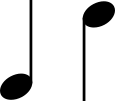
The crotchet or quarter note looks like this:
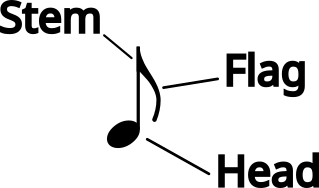
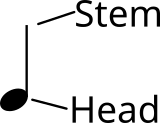
The crotchet is made up of two parts:

The stem can point up or down. Whether it points up or down will be explained in Note Names, so don’t worry about this just yet.
A crotchet or quarter note is normally equal to one beat in music.
While this is not always the case, different lengths of beats get quite complex, and will be explored in the later grades.

Crotchets
Here is what eight crotchets sound like when played one after another:
If an entire piece used just crotchets it would be very boring. So there are other notes that last longer or shorter. The next one we will explore is the Quaver or Eighth Note.
The Quaver or Eighth Note Value
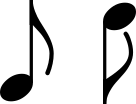
The quaver (UK) or eighth note (US) looks like this:
The quaver looks different to a crotchet. It is made up of these parts:
Like the crotchet, the quaver has the stem and head, but it also has a flag. The flag is what distinguishes the quaver from the crotchet, and determines it’s length compared to notes like semiquavers (covered later in this lesson).
It can also be wrote with it’s stem pointing up or down.
Each Quaver is half the length of a crotchet and is therefore half a beat.
Quavers
Here is what 16 quavers sound like when played one after another:
Crotchet and Quavers combined
To demonstrate the difference between quavers and crotchets, here is what eight quavers sound like when played at the same time as four crotchets:
The Minim or Half Beat
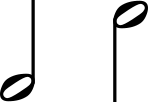
The minim (UK) or half note (US) looks like this:
Like the crotchet, the minim is made up of two parts: the stem and the note head. However, whilst the crotchet has a black head, the minim has a white head. This is how it is distinguished from the crotchet.
Again, the minim can point up or down.
Each minim is twice the length of a crotchet and is worth two beats.
The minim
Here is what four minims (the same number of beats as eight crotchets) sound like played one after another:
Combining Minims, Crotchets and Quavers
To demonstrate the difference between the notes we have looked at so far, here is minims, crotchets and quavers all played at the same time:
The Semiquaver or Sixteenth Note
The Semiquaver or Sixteenth note looks like this:
It looks similar to the quaver, however you’ll notice how it has two flags. The flags are what distinguish it from the quaver and determines it’s duration. It can point up or down.
A semiquaver a quarter of a beat. This makes it half the length of a quaver, and a quarter that of a crotchet.
The Semiquaver
Here is what 32 semiquavers (same length as eight crotchets) sound like played one after another:
Combining the Minim, Crotchet, Quaver and Semiquaver
Here is another recording of Minims, Crotchets, Quavers and Semi Quavers all sounding together, so you recognise the difference between the different notes:
The Semibreve or Whole Note
The final note you need to know about for grade 1 is the Semibreve (UK) or Whole Note (US). It looks like this:
Its different from other note values as it lacks a stem or flag, it is simply a head.
The semibreve/whole note value lasts four beats, and is the longest lasting note value you’ll need to know for some time.
The Semibreve
Here are 2 semibreves played one after another (equal to the eight crotchets you heard at the start of the lesson):
Combining Semibreves, Minims, Crotchets and Quavers
Here are Semibreves, Minims, Crotchets and Quavers played at the same time. There is no semiquavers being played, as this will help make it easier for you to hear the semibreve, and get an idea about it’s length:
Final Thoughts
Practically all western music is organised into a pulse or beat.
Different music note values have different durations and can take up more or less than one beat.
All the types of beats and notes divide easily into each other: